
Grieving the Death of a Child
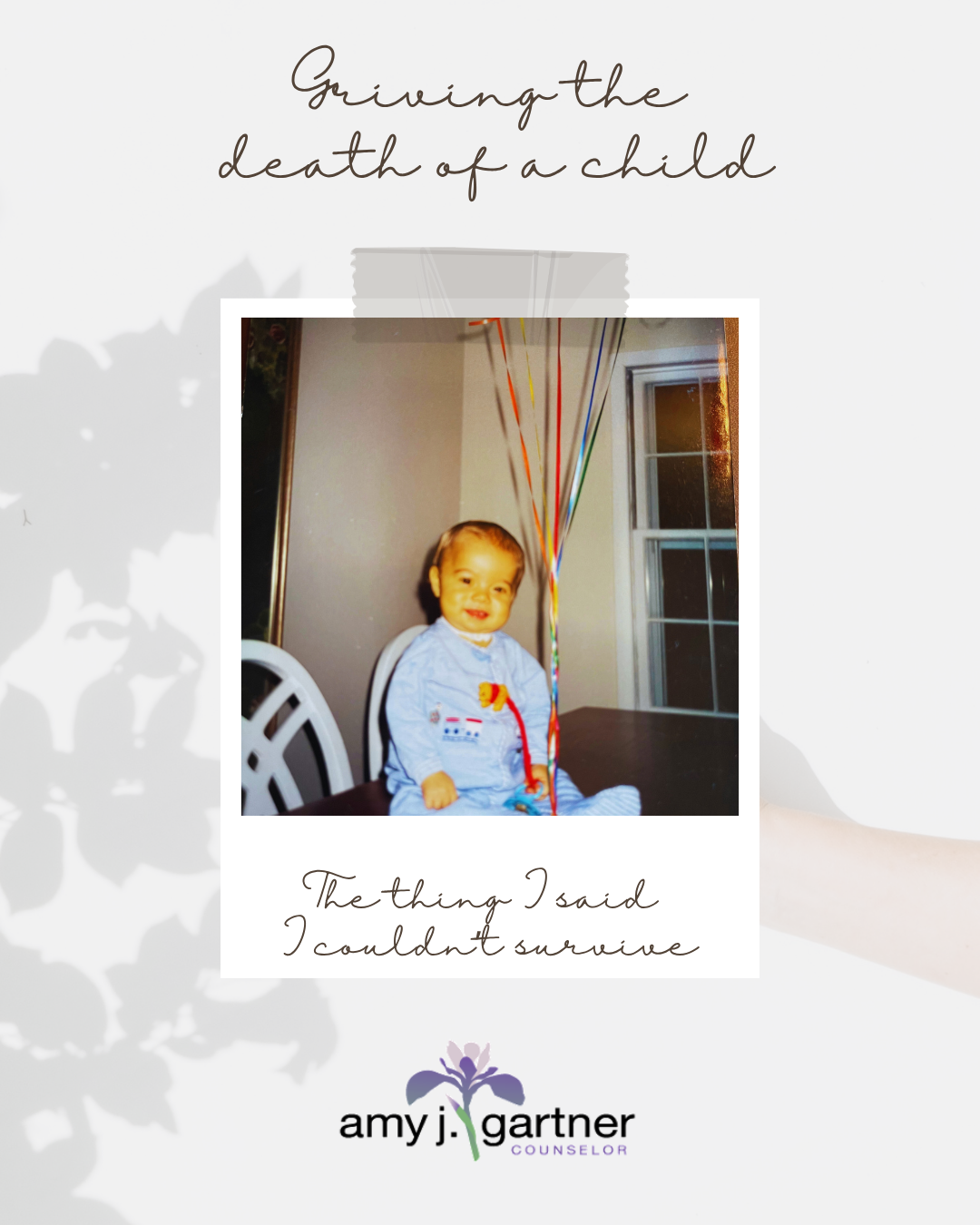
The Thing I Said I Couldn't Survive
After losing her son Will, Nashville grief therapist Amy J. Gartner shares what 25 years of child loss taught her about grief, love and survival.- Nashville Grief Therapist.
Before I met my son Will, I would have told you the one thing I could not survive was the death of one of my children.
And then I did survive it.
This month marks 25 years that we have lived without Will's physical presence. I'm here to tell you that we can survive unimaginable things. I'm not going to tell you it's pretty or that there's a bow on it. But we can.
Will's Story
Will was born on an unseasonably warm, sunny February day, and we believed he was perfectly healthy. At six weeks old, his pediatrician said he was concerned because Will wasn't gaining weight. One test led to another, and soon we were told there was an issue with his liver. It was all happening so fast it felt surreal. I was certain there would be a "quick fix." (Oh, sweet, hopeful me.)
Instead, a specialist diagnosed Will with biliary atresia, a rare liver disease whose only cure is a transplant. One very special doctor looked at us and said, "This is a marathon, not a sprint." Those words helped more than I can explain. They gave us reasonable expectations for how much our lives had just changed.
Will had surgery the morning after his diagnosis, hoping to buy him time. It wasn't successful. The older a child is at transplant, the better the odds, but Will didn't get that luxury.
At 7 months old, he received his first liver. His donor was a 5-year-old girl who had been killed while riding her tricycle. In the middle of their own unthinkable trauma, her family gave her organs to Will and several other children. I will never stop being grateful. Sadly, Will contracted a virus and lost that liver, and we went back on the list and waited.
And while we waited, we did what you do. We loved him and played with him. He and his big sister Abby had dance parties to The Wiggles. Abby sang, Will clapped, and honestly, it was the best show in town. We were in and out of the hospital, but whenever we were lucky enough to be home, we made the most of it.
The Night Before
The night before Will's second transplant, a nurse named Angel called to tell us a liver was coming from Minnesota. At 4 a.m., a helicopter landed on the roof of the hospital, and in a small igloo cooler was Will's new liver. (I know. You cannot make this stuff up.)
Will was ready. We had stayed up all night with him, given him a bath, read to him, held him, and sang with him. When it was time to leave the ICU for the OR, we walked beside his bed, and he rode through the hallways like a prince. Nurses, doctors, therapists, and so many others who knew Will lined the halls, cheering for him. He was smiling.
At the doors of the OR, I asked him if he wanted to dance. He lifted his arms for me to pick him up, and we danced, like we always did. When our song ended, I handed him to the anesthesiologist. Will looked over the man's shoulder and waved goodbye to us.
That was the last time I saw him alive.
When Life Kept Going
Will's heart stopped during the surgery. His surgeon told us this is common and that there are multiple ways to restart a heart during a transplant. Will didn't respond to any of them. To me, that said he had fought long enough and was ready to be at peace.
I found peace in that. I found peace knowing he wasn't suffering anymore, that he had felt loved through all of it, and that he'd had the very best care from an extraordinary team at Children's Memorial Hospital in Chicago. He had endured more than 20 surgeries and spent more than half of his short life in the hospital.
I also felt the most unimaginable pain: indescribable, gut-wrenching, otherworldly. Both were true at the same time. (Hold onto that one. It comes back.)
We spent the day with his body, and the doctors and nurses who had walked this road with us came in and out to sit with us. Our family and friends waited outside, showing up for us. We heal in connection.
When we finally left, I walked out of a place that had been a second home for a year and a half. My mom had stayed with me and Will at the hospital, so he was never alone, and so I could sleep a few hours in a conference room. My dad had been the constant for Abby, bringing her to see Will every other day. Will lit up when she walked in the room. We are not meant to do these hard things alone.
Outside, people were walking around, leaving work, running errands, going to the grocery store. How could life still be going on? Didn't they know my son had just died?
Standing there, I said to myself: I have a choice. I could feel this horrible, awful pain and take the unimaginable grief journey that would honor my pain and Will's life, and if I did, I would be okay, eventually. Or I could avoid the pain, distract myself, push it away, and it would haunt me and destroy me.
I chose the journey. I'd like to tell you I chose it gracefully. I did not.
Making Friends with Grief
Twenty-five years later, I carry grief with me. It's simply part of who I am. I made friends with it a long time ago. It's the friend who shows up unannounced, stays way too long, and occasionally takes over the whole couch. But grief is love, and if we're going to love, we're going to grieve. I consider it a privilege to know this pain, because pushing it away would mean pushing Will away, and that is unthinkable to me.
I didn't do it alone. I went to therapy. I attended a support group for parents grieving the death of a child. I am blessed with the most amazing friends and family. They grieved with me, they sat in my pain with me, they didn’t try to fix it, they witnessed my grief and held me through it. We are not meant to grieve alone. There were times I needed to be alone with it, to pour my pain into a journal or scream and cry. In the early days, I would drive Abby the ten minutes to preschool, come home and cry and scream and rant for two hours, throw cold water on my face, and go pick her up. She saved my life. She gave me a reason to get up in the morning, because small humans need to be fed, read to, and driven to places no matter what. But mostly, I grieved with my people.
Staying in Relationship with Will
The death of a child sits outside every framework we have. Parents aren't supposed to outlive their children. The nervous system has no map for it, no language, no script. The grief is severe, not because other losses are smaller, but because this was never supposed to happen.
So I made a choice to stay in relationship with Will, even though it doesn't look how I thought it would.
I talk about him all the time, and so do my kids. We visit the cemetery. His stocking hangs on the mantle next to his brother's and sister's, and yes, he gets an Easter basket. We tell stories and laugh about the fun we had with him. We imagine what he would say about some of the things his sister and brother are doing these days.
The monarch butterfly became our sign that he's still with us. A family friend painted an oil painting of a monarch that hangs in my bedroom. When any of us sees one, we text each other a photo: Will was on my hike today. At Abby's graduation, she said she wished Will were there, and moments later three monarchs swooped into the middle of us and took off. (Subtle, buddy.) When she graduated from college, she wore a tribute to Will on her cap. When my son got married this past March, my daughter-in-law asked everyone to wear a touch of purple and made sure every flower arrangement had some in it, because amethyst is Will's birthstone. My son mentioned his brother in his wedding vows.
Abby has been a faithful griever. A few months after Will died, she told me, "God owes us an apology for taking Will." Honestly, she wasn't wrong. She talked about him daily.
Patrick was born a year after Will died. My daughter says that Patrick came into our family when we needed a miracle and he helped us to heal. He didn't replace Will, and nothing could be further from the truth. He brought additional joy into our lives, and it turns out we can hold pain and joy at the same time. We made sure Patrick knew all about Will, the same way we talk about our children who are alive. When he was about four, he told us over dinner that he had met Will in heaven and that Will sent him to be with us. Just a normal Tuesday dinner. Patrick carries Will with him, a quieter griever; Will is with him always.
We are truly a family. One of us simply isn't here in a physical way.
What I Know Now
I don't like the phrase "it gets easier." It doesn't. What I can say is that if we are willing to walk through the pain (allow it, feel it, talk about it, write it, scream it, share it), then one day you realize it's a little more manageable. Grief doesn't leave. It settles into your soul and stays.
• Grief changes us. It rewires us, and it doesn't wait for us to be ready.
• Grief is not a weakness. It's the nervous system carrying something it was never meant to carry without support.
• Surviving isn't about stopping the feeling. It's about finding a reason to keep going despite it.
• Resilience isn't bouncing back. It's moving forward. You won't return to who you were before. You adapt, and you grow.
• Continuing bonds isn't only looking for signs. It's a slow process of finding ways to stay in relationship with someone who has died, letting them keep teaching me while I keep getting to know them.
Dr. Bessel van der Kolk teaches that unexpressed grief doesn't resolve with time, because time doesn't heal what was never allowed to be felt. Only feeling it does.
My children and I live the life Will wasn't able to live. We have full, joyful lives in spite of our grief, and we honor him by living them. He deserves nothing less. Suffering has taught me things comfort never could, and there is so much life on the other side of loss. Not because we "get over it," but because grief can slowly remake us into people with a deeper capacity for beauty, wonder, and awe.
If You're Grieving Right Now
Grief isn't a problem to be solved. It's a process to be lived. A few things I know to be true:
• It's held in the body, at a cellular level
• It's not linear. It's messy.
• Suppressing it is so very costly
• It changes shape but never ends
• The goal isn't to erase it but to integrate it into your life
• There is no timeline
• Small steps are enough
And here's how I walk through it:
• Let your support people be there for you, allow them to sit in the discomfort with you.
• Talk about them. They deserve to be remembered, and you need them to be.
• Feel it. Cry. Scream.
• Talk to them. Write them letters. Journal.
• Drink water, eat food, sleep, take a walk. (Yes, really. Start there.)
If you are looking for a trauma therapist in Nashville, Tennessee, I would be honored to walk alongside you. I offer grief and trauma counseling, Brainspotting, and body-aware therapeutic support from my office on Music Row in Nashville.
You deserve the opportunity to heal and experience greater peace.
Written by Amy J. Gartner, LCSW
Certified Brainspotting Therapist
Specializing in grief, trauma, Brainspotting, life transitions, and emotional eating.